

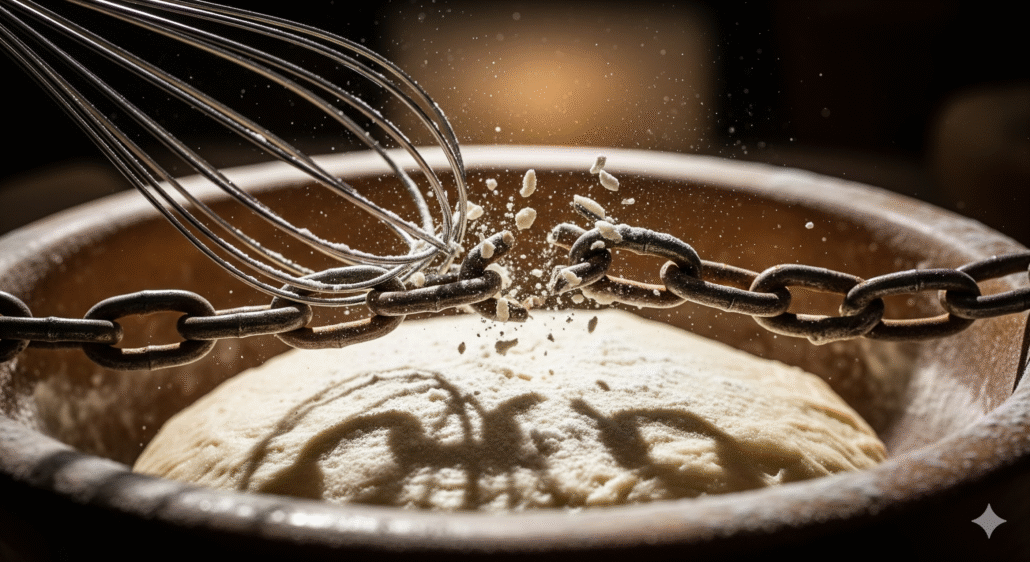
The Baking Rules I Broke (And Why You Should, Too)
When I first started my baking journey, I treated recipes like sacred texts. Every measurement was exact, every instruction followed to the letter. Sift if it says sift. Mix for exactly two minutes. Never, ever question the process. Fearful of failure, I became a recipe robot.
But as I’ve worked on developing recipes for my own home-baking business here in Pennsylvania, I’ve learned that the most significant growth comes from asking one simple question: Why?
Understanding the science and the function behind each ingredient and step is far more valuable than blindly following instructions. It’s the difference between merely executing a recipe and truly baking. It’s how you learn to innovate, substitute, and create treats that are uniquely yours. Here are a few “rules” I learned to question, and eventually break, on my way to becoming a more confident baker.
The Great Egg Debate: Is it Really Necessary?
Eggs are a powerhouse in baking, no doubt. They add fat, moisture, structure, and leavening. But do you need them in every recipe that calls for them? The answer is a resounding no.
Often, particularly in cookies and some dense cakes, the primary job of the egg is simply to act as a binder, holding everything together. Once I realized this, a world of possibilities opened up. If binding is the only goal, you can use a “flax egg” (one tablespoon of ground flaxseed mixed with three tablespoons of water) to do the same job beautifully.
But what about recipes where the egg’s protein and aeration properties are the star of the show? You can’t just swap in a flax egg for a meringue or an angel food cake and expect the same light, airy result. This is where another magical substitute comes in: aquafaba. The viscous liquid from a can of chickpeas can be whipped just like egg whites to create stunning, stable meringues, macarons, and mousses. By questioning the egg’s purpose, I’ve been able to adapt even complex recipes to be vegan-friendly, making my treats accessible to more people.
Going Against the Gluten Grain
My next challenge was gluten. I wanted to start creating delicious gluten-free options, so I began to look at flour differently. The default is all-purpose flour, which contains a moderate amount of protein that forms gluten when mixed with water.
For a chewy loaf of bread, gluten is your best friend. It creates the strong, elastic network needed to trap gasses and give the bread its signature structure. But what about a cookie?
Take a classic shortbread, for example. The ideal shortbread is tender, delicate, and crumbly—the very antithesis of chewy. In this case, gluten is actually the enemy. Developing gluten would make the cookie tough. By understanding this, I can confidently swap in gluten-free flour blends for recipes like shortbread, knowing that I’m not just avoiding an allergen, I’m actually improving the final texture.
To Sift or Not to Sift?
Nearly every classic baking recipe starts with the instruction: “sift your dry ingredients.” For years, I did it without question. But is it really necessary?
For all-purpose flour, the answer is almost always no. Modern flour milling is incredibly fine, and anti-caking agents are often added, meaning the flour I buy is rarely clumped together. As someone who bakes frequently, my flour turnover is high, so it never has a chance to compact in the bag. Skipping the sifting step saves time and a little bit of cleanup.
However, this rule doesn’t apply to everything. Some ingredients are notorious for clumping. I always sift cocoa powder, almond flour, and cornstarch. These ingredients are prone to forming stubborn lumps that won’t break up in the mixer, leaving you with little pockets of dry powder in your finished product. So, before you sift, ask if the ingredient actually needs it.
Breaking Up with Old Yeast Myths
Bread was one of my biggest hurdles, and it came with a lot of dogma, especially around yeast. Here are two pieces of common wisdom I’ve learned to ignore.
First, the idea that you must activate active dry yeast in warm water and sugar. As long as I know my yeast is fresh (i.e., not past its expiration date), I throw it directly into the mixer with my flour and other dry ingredients. Modern yeast is incredibly stable and reliable. The activation step is really just a holdover to prove your yeast is alive, but if you store it properly and buy it fresh, it’s a step you can almost always skip.
Second, the famous warning—often repeated by baking giants like Paul Hollywood—that salt and yeast must be kept on opposite sides of the mixing bowl lest the salt kill the yeast. While it’s true that a high concentration of salt can inhibit or kill yeast, the fear is overblown. Think about it: all the ingredients are going to be intimately mixed together in about 30 seconds anyway. The brief moment they might touch in the bowl isn’t going to doom your dough. I now add my salt and yeast to the bowl without a second thought, and my bread rises beautifully every time.
Your Turn to Be a Rebel
Questioning these rules didn’t lead to disaster. It led to discovery. It gave me the confidence to experiment, to substitute ingredients, and to truly understand my craft. So next time you’re in the kitchen, I encourage you to ask “why.” Why does this recipe need an egg? Why am I kneading for 10 minutes? Why do I have to preheat the oven so high?
You might find there’s a very good reason. Or, you might just discover a new, better way of doing things.
What baking “rules” have you learned to break? Share them in the comments below!

